Nearly 1 in 8 men will be diagnosed with prostate cancer during their lives. It is the most common cancer among men in the U.S., except for skin cancer. Localized Prostate Cancer is found early, and hasn’t spread outside the prostate. It’s usually less aggressive.
Some men with this condition may have urinary problems. However, many do not show any symptoms early on.
Knowing your treatment options is crucial. They range from active surveillance to surgery and radiation. Men with early-stage localized prostate cancer have a high survival rate. Understanding your prostate tumor helps in picking the best treatment. For more details, visit WebMD.
Key Takeaways
- Localized prostate cancer is often asymptomatic and detected through screenings.
- Treatment options include watchful waiting, active surveillance, surgery, and radiation therapy.
- High survival rates are associated with early-stage prostate cancer.
- The Gleason score helps determine the aggressiveness of the tumor.
- Understanding risk factors can improve early detection and treatment effectiveness.
Understanding Localized Prostate Cancer
Localized prostate cancer is an early stage cancer. It stays inside the prostate gland. This is important because it’s not as severe as cancer that has spread. Many men don’t know they have it until a screening test finds it. These cancers usually grow slowly.
Not all localized prostate cancers are the same. Some grow fast and can spread. Treatment needs to fit each person’s cancer. It depends on how fast the tumor grows and other health scores.
The range of treatment choices includes:
- Active surveillance
- Watchful waiting
- Surgery (e.g., radical prostatectomy)
- External beam radiation therapy
- High dose-rate brachytherapy
- Permanently implanted seed brachytherapy
- High-intensity focused ultrasound (HIFU)
- Cryotherapy
Follow-up visits and PSA blood tests are crucial. They help check if treatment is working. The outlook for each man varies. It depends on many factors like cancer stage and health. The success of treatment can vary, and some might need more treatment later.
There is support for men with this diagnosis. They can find help from nurses, websites, and get advice on how to cope. Knowing the risk group is crucial. It helps manage the patient based on cancer stage, PSA levels, and Gleason scores.
Symptoms of Localized Prostate Cancer
Early on, symptoms of localized prostate cancer might not be noticeable. Yet, as the disease gets worse, these signs become clearer. Knowing these symptoms is key for early detection and treatment. Learning about Prostate Cancer Symptoms encourages prompt medical advice and planning of treatment.
Common urinary symptoms
Urinary symptoms might be the first thing people notice. Such early signs can include:
- Urgent need to urinate
- Difficulty in starting or stopping urination
- Weak urine stream
- Frequent urination at night
These symptoms can really affect daily life and well-being. Men with these urinary symptoms should get help from a doctor.
Recognizing late-stage signs
As the cancer grows, more serious symptoms may show up. It’s critical to know these signs for the right care. Signs of late-stage can include:
- Blood in the urine
- Pain in the pelvic area
- Changes in bowel habits
- Unexplained weight loss
Being aware of these late signs is important for treatment discussions. Looking into resources like localized prostate cancer treatment options offers useful info for effective management.

Screening and Diagnosis of Prostate Cancer
Screening is key in catching prostate cancer early. There are two main ways to diagnose it: the Prostate-Specific Antigen (PSA) test and the Digital Rectal Exam (DRE). These methods share vital info on prostate health, guiding what comes next in care.
Prostate-specific antigen (PSA) tests
The PSA test looks for a specific marker in the blood, with normal being under 4 ng/mL. A PSA level of 4 to 10 means there’s a 25% chance of cancer, often low-grade. Over 10, and that chance goes above 50%. Keeping track of PSA numbers is important for figuring out treatment plans.
Digital rectal exam (DRE)
In a DRE, a doctor checks the prostate through the rectal wall to spot any oddities. This exam, along with PSA tests, pinpoints any worries. When these tests show something off, more steps like imaging or biopsies may be needed to confirm cancer.
Biopsy results usually come back in 1 to 3 days, though sometimes it takes longer. If the first biopsy is clear but cancer is still suspected, another biopsy may be needed. Knowing these steps helps deal with the process of diagnosing prostate cancer.
Grading and Staging of Localized Prostate Cancer
Grading and staging are key in assessing localized prostate cancer. They help figure out how aggressive the cancer is. This shapes the treatment approach.
Understanding the Gleason score
The Gleason score is crucial for prostate cancer grading. It checks how much cancer cells look like normal ones. A score from 1 to 5 is used. A lower score means the cancer is not very aggressive. A higher score indicates it might grow quickly and spread.
This score is part of the Grade Group system. It divides cancers into five risk categories.
TNM staging system
The TNM Staging System is widely used to classify prostate cancer. Created by the AJCC, it looks at tumor size, lymph node status, and if there’s spread. These factors decide the cancer’s overall stage. Stages range from I, localized cancer, to IV, where it’s spread far.
Understanding the stage helps plan the treatment.
| Stage | Description |
|---|---|
| Stage I | Localized cancer with low PSA levels and minimal tumor spread. |
| Stage II | Localized disease, possibly larger tumors but still confined to the prostate. |
| Stage III | Cancer that has extended beyond the prostate to nearby tissues. |
| Stage IV | Cancer has spread to distant parts of the body. |
By using both the Gleason score and TNM Staging, doctors can pinpoint prostate cancer stages precisely. This method categorizes patients into risk groups, crucial for picking the right treatment.

Risk Factors and Prognosis
Knowing the risk factors for localized prostate cancer helps with prevention and early detection. Some groups have a higher chance of getting it. This shows why focused awareness and screening is key for those at risk.
Identifying high-risk groups
Age is a big factor in prostate cancer, with most cases found in men over 65. Ethnicity also affects risk. Men of African American and Caribbean descent get prostate cancer younger. Having a family history increases the risk. If a man’s father or brother had it, his risk doubles. Genetic changes like BRCA1 and BRCA2 genes also add to the risk. Other possible risk factors are:
- Eating a lot of dairy might slightly raise the risk.
- Being obese may lead to more severe types, though it’s not always linked to a higher risk.
- Chemicals like arsenic and Agent Orange can increase the risk.
- The link between sexually transmitted infections and prostate cancer isn’t clear.
Survival rates and long-term outlook
The outlook for localized prostate cancer is typically good. Many patients live longer than five years after being diagnosed. Research shows men with early-stage prostate cancer have survival rates similar to men without it. This points to the effectiveness of early treatment and management.
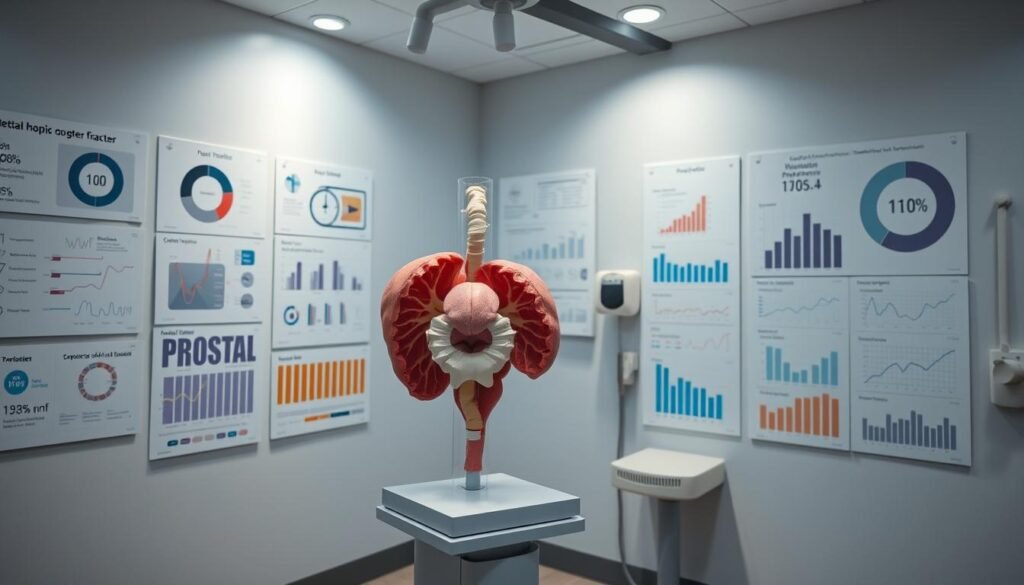
Localized Prostate Cancer: Treatment Options
The Localized Prostate Cancer Treatments scene offers different strategies based on patient needs. Many factors play a role in choosing the right Prostate Cancer Treatment Options. Patients and doctors should discuss these together. Options include radical prostatectomy, radiation therapy, and active surveillance.
Radical prostatectomy is a top choice for men under 70 who are in good health. After the surgery, outcomes can differ a lot. Incontinence rates vary, reported between 0% and 12% after 6 to 24 months.
Recovery of potency varies too. Based on reports, recovery rates differ. Physician-reported outcomes show 75% to 86%, but surveys point to 30% to 35%.
For those with low to intermediate risk, 5-year survival rates after surgery look good. In Canada, these rates range from 65% to 92%. The 10-year survival rate hovers around 75%. Recently, prostate brachytherapy has grown in approval for treating Localized Prostate Cancer.
Active surveillance is now a main strategy. It calls for close monitoring without rushing into treatment. The choice of treatment looks at the cancer’s severity, patient’s age, health, and preferences. Note: Less than 5% of men over 75 in the U.S. choose surgery.
It’s key to understand the side effects of treatments. Surgery may better urinary flow but bring unwanted effects like increased urgency. Radiation, especially SBRT, involves fewer appointments but can have complications.
Surgery and radiation carry risks but can better life quality. Despite risks, about 94% with this cancer go for treatment. Yet, overtreatment affects about 55%, underlining the need for careful discussion about Prostate Cancer Treatment Options.
Knowing these options aids in careful decision-making. Tailored talks and joint decisions can boost satisfaction with care and outcomes.
For more info on these treatments, see here: treatment choices for localized prostate cancer.
Active Surveillance vs. Watchful Waiting
Choosing between Active Surveillance and Watchful Waiting is crucial for people with localized prostate cancer. These methods focus on watching the cancer without rushing into treatment. They are different in how they monitor and their goals.
Defining active surveillance
Active Surveillance involves close monitoring through tests. This includes visiting doctors every six months for a PSA blood test. Every year, a patient gets a digital rectal exam (DRE). They also have prostate biopsies and MRI tests every 1 to 3 years. This is for patients with slow-growing cancer that hasn’t spread beyond the prostate. It’s best for those at very low, low, or favorable intermediate-risk.
Understanding watchful waiting
With Watchful Waiting, the follow-up is less frequent. Patients have a PSA test once a year. They wait for symptoms to change before deciding on treatment. This choice is often for older people or those with serious health issues. Here, treatment may focus on hormone therapy to control growth, not to cure.
| Aspect | Active Surveillance | Watchful Waiting |
|---|---|---|
| Monitoring Frequency | Every 6 months for PSA; annual exams and biopsies every 2-5 years | At least once a year for PSA; less frequent overall |
| Patient Eligibility | Slow-growing, localized tumors; low PSA levels | Older patients or those with other health concerns |
| Treatment Approach | Potential treatment upon symptom development or signs of progression | Focus on managing symptoms; hormone treatments may be used |
| Anxiety Levels | Regular monitoring may induce anxiety in some | Some prefer less intense monitoring to avoid concerns |
Active Surveillance might offer a similar life expectancy to immediate treatments like surgery or radiation. For those deciding their path, understanding these approaches is important. This helps choose a plan that fits personal health and preferences.
Invasive Treatment: Radical Prostatectomy
Radical prostatectomy is a common recommendation for men with localized prostate cancer. It’s especially suggested for those expected to live longer. The surgery removes the prostate gland and nearby tissues. This can greatly lower the death risk from prostate cancer.
Procedure overview
Surgeons may choose robotic or open surgery for a radical prostatectomy. The choice depends on the patient’s health and cancer’s spread. Robotic surgery is popular in the U.S. because it often means less blood loss and pain. It also requires a shorter hospital stay.
Despite the differences, robotic and open surgery have similar long-term effects on sexual and urine control. Skilled surgeons work to reduce these risks and improve recovery.
Potential side effects
Radical prostatectomy can lead to urinary incontinence and erectile dysfunction. These side effects can impact life after surgery. After ten years, about 173 out of 1,000 men may struggle with urine control. About 389 out of 1,000 might face issues with erectile function.
Knowing these risks is important. Talking with doctors about managing them after surgery is crucial. For detailed info, click here.
Radiation Therapy for Prostate Tumors
Radiation therapy is key for treating prostate cancer. It includes methods like External Beam Radiation Therapy and Brachytherapy. These methods help destroy tumor growth. They let patients choose their treatment wisely.
External beam radiation therapy
External Beam Radiation Therapy (EBRT) is widely used. It sends targeted X-ray beams to the cancer spots. It works for both early and advanced prostate cancers. It is useful even when cancer has spread beyond the prostate.
Treatments occur five days a week for several weeks. They take place in an outpatient setting, making it convenient. Techniques like Intensity-Modulated Radiation Therapy (IMRT) and Proton Beam Therapy increase precision. They also protect healthy tissues. EBRT and hormone therapy together can improve survival chances for high-risk patients. Recent studies show EBRT’s cure rates for localized prostate cancer are as good as surgery’s.
Brachytherapy overview
Brachytherapy involves planting tiny radioactive seeds inside the prostate. The seeds can be permanent or temporary. This method hits the target well, saving healthy tissues around it. As a result, patients face fewer side effects.
Patients with low-risk prostate cancer see good results from Brachytherapy. Almost 90% are free from cancer recurrence after 10 years. Combining Brachytherapy with EBRT works even better for those with intermediate and high-risk.
Both radiation methods, EBRT and Brachytherapy, are crucial for fighting localized prostate cancer. Knowing your risk and cancer type helps choose the best treatment. For more on prostate cancer causes and risks, check this link.
Conclusion
Managing localized prostate cancer is a complex task. It includes knowing about symptoms, diagnosing, risk factors, and treatment choices. Most men discover their cancer is still only in the prostate gland. This fact gives hope. Many of these men go on to live long and healthy lives after treatment.
Knowing the latest in prostate cancer treatments helps make wise care choices. It’s crucial to talk openly with your healthcare team. This lets you plan your treatment better. Treatments like surgery, radiation, and watching the cancer vary in how well they work. Some studies show benefits of surgery, especially in men younger than 65 or those at intermediate risk. Yet, surgery can lead to issues like problems with urination and sexual function.
The fight against localized prostate cancer needs both the patient and doctors to work together. They must stay informed as research gets better. Keeping up with new studies helps improve outcomes. It also raises the quality of life for those dealing with this disease.