Did you know the prostate is as small as a ping-pong ball? Despite its size, this gland is key for the male reproductive system. It aids in making semen and impacts urinary health. Knowing where the prostate sits helps in spotting health issues early and keeping fit. This piece will walk you through the prostate’s anatomy, its position relative to other organs, and what affects its health. This will make understanding this important body part easier.
Key Takeaways
- The prostate is about the size of a ping-pong ball.
- Most prostate cancers start in the peripheral zone, close to the rectum.
- Benign Prostatic Hyperplasia (BPH) can cause pee problems, especially in older men.
- For male fertility, prostate’s role in semen production is critical.
- The peripheral zone forms around 70% of the prostate’s tissue.
Understanding the Prostate Anatomy
The prostate gland is key for male reproductive health. It has a special structure and vital roles. Looking closely at the prostate shows its zones and tissues, affecting its work in the body.
Structure and Tissue Composition
The prostate is made of different tissues, each adding to its job. It has three main zones:
- P Peripheral Zone: This area is about 70% of the prostate’s size and wraps around the central zone. It’s where prostate cancer often starts.
- Central Zone: This part is 25% of the prostate and is less prone to cancer.
- Transition Zone: It’s only 5% of the gland, around the urethra, and important for peeing.
Its tissue is mostly glandular, creating prostatic fluid, and fibromuscular, giving it structure. Knowing these tissues helps us understand the prostate’s roles.
Key Functions of the Prostate
The prostate has several major roles in male health:
- It adds fluids to semen, helping sperm move and stay healthy.
- It helps push semen out during ejaculation.
- It surrounds the urethra, aiding in urine control.
To sum up, the prostate’s structure and tissues are crucial for its job and overall health. Understanding this is key for prostate health knowledge.
Where is the Prostate Located
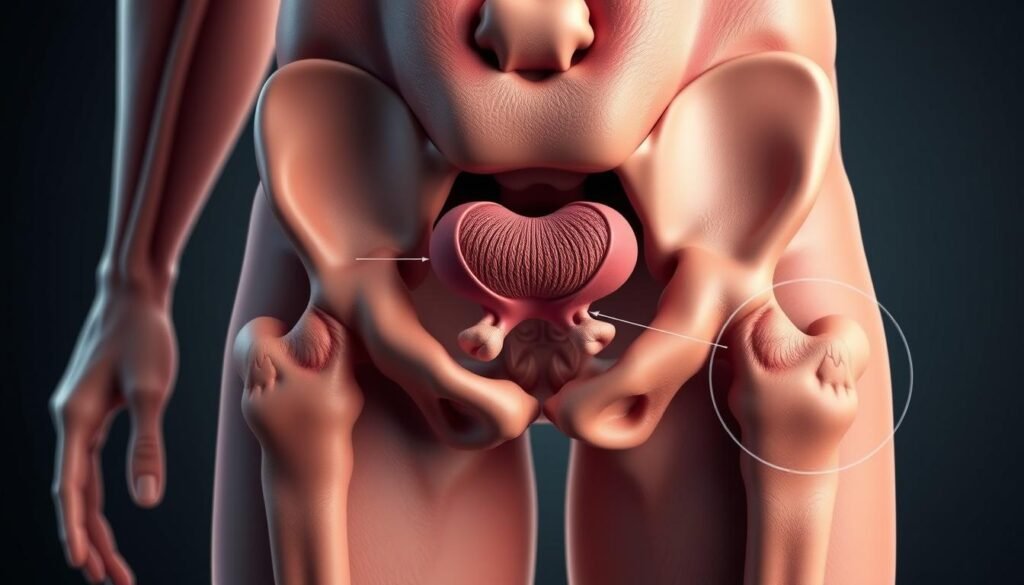
The prostate is key to the male reproductive system. Knowing where it’s located helps identify health issues. It’s under the bladder, behind the pubic symphysis, above the membrane by the rectum, and wraps around part of the urethra. This position affects urinary functions as men get older, often due to benign prostatic hyperplasia (BPH). Images help us grasp how the prostate fits with nearby organs.
Distance and Position Relative to Other Organs
The prostate’s position is near crucial parts within the male pelvis. It’s about the size of a ping-pong ball, weighing around 30 grams. About 70% of it is in the peripheral zone. This area is key since most prostate cancers start here. Its closeness to the bladder and rectum highlights its role in both urination and reproduction.
Visual Mapping of Prostate Placement
https://www.youtube.com/watch?v=qkWSE5Ro1GY
Diagrams and images are great for showing the prostate gland location and its relationship to other pelvic organs. The central and transition zones differ greatly in size. The central zone makes up about 25% of its weight. The transition zone is the smallest, at just 10% of the gland. Diagrams show that BPH usually happens in the transition zone, while cancer often starts in the peripheral zone. This tells us regular check-ups are vital.
For more details on the prostate’s anatomy and role, check this resource.
The Prostate Gland Position in the Male Reproductive System
The prostate gland plays a key role in men’s health. It sits in a critical area for urinary and reproductive functions. Knowing where the prostate is helps us understand its importance in male anatomy.
Connection to the Bladder and Urethra
The prostate is right below the bladder and near the rectum. This spot is vital for its double role. It touches the bottom of the bladder, linking it to pee control. The urethra, running through the prostate, carries pee and semen. This setup shows the prostate’s key role in men’s health.
Role in Semen Production and Ejaculation
The prostate is central in making semen. It makes a fluid that’s a big part of semen. This fluid helps and protects sperm.
The gland has three parts which help it secrete nutrient-rich fluid. This fluid mixes with another from the seminal vesicles. Together, they make semen. The prostate may be small, but it’s mighty in male fertility.

| Component | Function |
|---|---|
| Prostate Gland | Produces prostatic fluid, aids in semen composition |
| Bladder | Storage of urine, involved in urinary control |
| Urethra | Channel for urine removal and semen passage during ejaculation |
| Semen Vesicles | Contributes up to 80% of ejaculated fluid |
| Bulbourethral Glands | Produce lubricating fluid to neutralize urethral acidity |
Prostate Placement: Dimensions and Size
The prostate gland is crucial for male reproductive health. It plays a key role. Factors like prostate placement and size are important to know. This helps us understand changes due to aging. A healthy prostate weighs about 20 grams. It’s usually 3 cm long, 4 cm wide, and 2 cm deep. However, these typical size measurements change as men get older.
Typical Size Measurements
Throughout life, the prostate changes size. This starts in the 30s and continues as men age. The average size reflects a healthy prostate. But, it can grow larger because of conditions like benign prostatic hyperplasia (BPH). Important to note, about 8 in 10 men will face an enlarged prostate. This highlights the need to know about size changes with age.
Changes in Size with Age
With age, the prostate often gets bigger. By 60, half of men might have symptoms of enlargement. This chance increases to 90% for those over 80. Such enlargement can affect urinary function and prostate health. It’s vital to get regular screenings to catch issues early.
For more details on prostate health, discussing risks and screenings with a doctor is wise. This is especially true for those in high-risk groups according to the American Cancer Society. Catching problems early is key in keeping the prostate healthy.
| Age Group | Likelihood of Enlarged Prostate Symptoms |
|---|---|
| Under 50 | Less than 20% |
| 50-60 | 50% |
| 60-70 | 70% |
| Over 80 | 90% |
Understanding Prostate Anatomy Through Diagrams
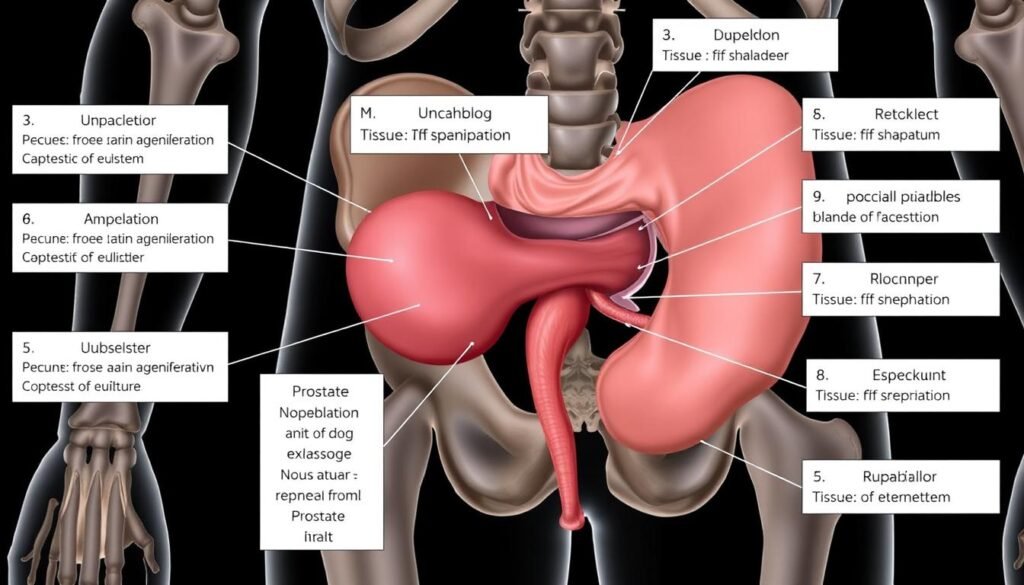
Visual aids like diagrams make it easier to understand the prostate’s anatomy. They especially help show where the prostate is and how it relates to nearby organs. Using prostate anatomy diagrams and prostate location illustrations is key to simplifying these complex ideas.
3D Models of Prostate Location
Three-dimensional models offer a detailed view of where the prostate sits in the male body. They don’t just show the prostate. They also highlight its connections to the bladder and urethra. This kind of detail is crucial in understanding how issues like BPH and prostate cancer affect a person.
Illustrations of the Surrounding Structures
Looking at the structures around the prostate can also provide more insight. Illustrations help show how the prostate interacts with nearby organs. This is very helpful in learning how different diseases impact the urinary and reproductive systems. Getting a hold of accurate prostate anatomy diagrams and prostate location illustrations is vital for anyone eager to learn more about prostate health.
Conditions Affecting Prostate Location and Function
Several conditions can change how the prostate works and where it’s located. Knowing about these is key to spotting them early and managing them well. Benign prostatic hyperplasia (BPH) and prostate cancer are two main issues. Both can cause a lot of health problems.
Benign Prostatic Hyperplasia (BPH)
Benign prostatic hyperplasia means the prostate gets bigger but isn’t cancerous. It happens often in aging men. By age 60, the prostate might get as big as a lemon. This can lead to trouble with peeing, like:
- Needing to pee more often
- Struggling to start or stop peeing
- Weak urine flow or dribbling
- Not being able to pee, which needs quick help
BPH can’t be cured, but there are treatments. These treatments can really help make life better for those dealing with it.
Prostate Cancer and Its Impact on the Gland
Prostate cancer is a major health concern for men, especially those over 50. It is most common in African American men, then White, Hispanic, and Native American men. Having a family history of prostate cancer raises the risk. This is especially true if your dad or brother had it young.
Early on, prostate cancer might not cause symptoms. This makes finding it early tough. Men between 55 and 69 should get the PSA test for early spotting. The median age for finding prostate cancer is 66. About 1 in 8 men will face it in their lifetime.
As prostate cancer grows, it may cause peeing problems and discomfort. It’s vital to know the signs and risks for early action and treatment.
Symptoms Related to Prostate Location Issues
Prostate issues can show up in different ways, pointing out key signs not to overlook. For men over 50, knowing the symptoms of prostate issues matters a lot. One widespread condition is benign prostatic hyperplasia (BPH). It often changes how you urinate and affects comfort.
Common Symptoms of BPH
Many older men experience signs of BPH. Important symptoms to watch for include:
- Frequent urination, especially at night
- A weak or slow urine stream
- Struggle to start urinating
- Not being able to empty the bladder fully
- Feeling a sudden need to urinate
Knowing these symptoms helps people seek help early. If BPH isn’t treated on time, it can lead to more problems. This shows why acting quickly is key.
Symptoms Indicating Potential Prostate Disorders
More dangerous conditions, like prostate cancer, may bring different issues. Symptoms that need fast doctor’s appointment include:
- Painful urination or during ejaculation
- Blood in urine or semen
- Pain or discomfort in the pelvic area
- Having trouble with urinating
- Sudden weight loss or fever without reason
Prostate cancer ranks as the second most common cancer for men in the UK. Knowing these symptoms of prostate issues is vital. Catching it early can make treatment more effective. To learn more about prostate cancer, visit Mayo Clinic.
Spotting the signs of benign prostatic hyperplasia and other prostate disorders is key for good prostate health. Getting regular check-ups and keeping informed makes a big difference for men facing these symptoms.
| Symptom | Condition |
|---|---|
| Frequent urination | BPH |
| Weak urine stream | BPH |
| Painful urination | Prostate Cancer |
| Blood in urine | Prostate Cancer |
| Pelvic pain | Prostate Cancer |
How to Monitor Prostate Health
It’s important to watch your prostate health closely. Men over 50 should see their doctor regularly. These visits help catch and treat any issues early on.
Regular Check-Ups with a Healthcare Provider
Prostate exams are key in spotting health issues early. Doctors look for signs of enlargement, bladder problems, and cancer. As you get older, you’ll need these checks more often. Some start these exams at 40.
At these appointments, you might get a PSA blood test or a digital rectal exam (DRE). Both are important.
Here’s what to remember about these visits:
- Men 50 and up usually get a DRE during their check-up.
- A high PSA level might mean needing more tests, like a biopsy or imaging.
- Keeping an eye on your prostate is about following doctor’s advice and knowing your body.
Importance of Digital Rectal Examinations (DRE)
The DRE is a critical part of checking prostate health. It lets doctors feel for problems. Though it might seem awkward, it’s quick and important.
The DRE is especially valuable for a few reasons:
- It can spot cancer even if PSA levels are okay.
- You get instant feedback on your prostate’s health.
- You can talk any worries over with your doctor beforehand.
| Test | Purpose | Age Recommendation |
|---|---|---|
| PSA Blood Test | Detect high levels indicating potential prostate cancer | Starting at age 40 |
| Digital Rectal Exam (DRE) | Check for abnormalities in the prostate | Starting at age 50 |
| Prostate Biopsies | Confirm presence of cancer if PSA levels are high | As required based on test results |
Regular prostate check-ups and knowing the role of DREs are crucial. They keep you healthy and informed. Be active in your healthcare and work closely with your doctor.
Conclusion
Knowing where the prostate is and how it relates to other parts of the body is key for men’s health. It helps in understanding the role of the prostate. It also stresses the need for early health issue detection and handling. Prostate cancer makes up more than a quarter of all male cancers. Teaching about its risks and symptoms can improve health.
Each year, around 395,000 men find out they have prostate cancer. The older a man gets, the higher his risk. This shows why men, especially those older than 50, should take charge of their health. They should get regular checks. Learning about the prostate helps men talk better with doctors about tests like the PSA screening.
Adding regular checks and screenings to health routines raises the chances of beating cancer if it comes. Knowing symptoms early, like painful peeing or back pain, can get you to a doctor sooner. For more on prostate health, see this informative resource. Caring about prostate health means a better future for men everywhere.