Every year, over 1.7 million new cancer cases are found in the U.S. Prostate cancer makes up about 19% of these. This high number shows how much we need new ways to fight cancer, like radiopharmaceuticals. These treatments focus on prostate-specific membrane antigen (PSMA) and are changing the game in prostate cancer therapy. They are specially made to attack cancer cells and help doctors make better diagnoses. As experts study these treatments more, they are finding they could help with not just prostate cancer, but other kinds too.
These discoveries show the growing power of radiopharmaceuticals targeting PSMA in prostate cancer. They are changing how we treat patients, focusing on what each person needs. This marks the start of a new chapter in fighting cancer.
Key Takeaways
- Prostate cancer represents about 19% of all new cancer cases in the U.S.
- Radiopharmaceuticals targeting PSMA offer tailored treatment options through precision oncology.
- Innovative therapies show significant progress in the diagnosis and treatment of advanced prostate cancer.
- PSMA-targeted agents are being researched for their potential application in other types of cancer, like breast cancer.
- The FDA has approved several radiopharmaceuticals, enhancing treatment options for prostate cancer patients.
Introduction to Radiopharmaceuticals in Prostate Cancer
Radiopharmaceuticals offer a new way to fight prostate cancer. They are especially useful for patients with advanced stages of the disease. These treatments combine a radioactive element with a molecule that targets cancer cells. This means they can directly attack the cancer at its source.
Over the years, the role of radiopharmaceuticals in cancer treatment has grown. For example, the FDA approved radium-223 (Xofigo) in 2013 for certain prostate cancer patients. It has been key in helping patients live longer and with less pain.
In 2022, another breakthrough came with the FDA’s approval of lutetium Lu 177 vipivotide tetraxetan (177Lu-PSMA-617, Pluvicto). This drug targets a specific prostate cancer marker. Studies showed it significantly prolonged the time patients lived without cancer worsening, compared to standard treatments.
Research into actinium-225 PSMA radioligand therapy is also promising. It has shown the potential to extend life in advanced prostate cancer patients. Scientists are working on new ways to make these treatments even more effective. As these therapies become more common, improving their safety and results is a key goal.
Understanding PSMA: A Key Molecular Target
Prostate cancer is a major health issue for men around the world. It is the second most common cancer and ranks fifth in cancer deaths among men. This situation calls for effective treatments. One promising approach is molecular targeted therapy. At the heart of this progress is PSMA, or prostate-specific membrane antigen.
PSMA levels are much higher in prostate cancer cells than in healthy ones, often 100 to 1000 times more. This makes PSMA a prime target for new treatments. It is closely linked with the disease’s growth and severity. PSMA is most present in advanced cancers, making it a key target for therapy.
Recent FDA approvals highlight the focus on PSMA for treatment. 177Lu-PSMA-617 is a new therapy targeting PSMA directly. Studies like the VISION trial show it can extend life by four months in patients with advanced cancer. This underscores the success of PSMA-targeted treatments and their potential benefit for patients.
For diagnosing prostate cancer, PSMA-PET imaging has been a game-changer. It’s more sensitive and specific than standard methods. 68Ga-PSMA-11 and 18F-DCFPyL are two FDA-approved agents that use PSMA. They help doctors see the cancer better and make smarter treatment choices, especially in severe cases.
PSMA imaging plays a key role in detecting cancer return after surgery or radiation. It successfully finds cancer in about 95% of primary cases and in lymph node spread. This shows the huge potential of targeting PSMA in treatment plans.
PSMA connects imaging and therapy in treating prostate cancer. Exploring its uses and effects helps doctors better manage this widespread disease. Through such efforts, we’re improving the outlook and life quality for those living with prostate cancer.
Radiopharmaceuticals Targeting PSMA in Prostate Cancer
PSMA-targeted radiopharmaceuticals are a big step forward in treating metastatic prostate cancer. Agents like [68Ga]PSMA-11 and [177Lu]PSMA-617 target tumors that express the PSMA protein. They make treatments more effective and protect healthy tissues.
Overview of PSMA-targeted radiopharmaceuticals
[177Lu]PSMA-617, also known as Pluvicto, was a major breakthrough. The FDA approved it on March 23, 2022. It’s meant for adults with metastatic prostate cancer that resists hormones and makes too much PSMA. These treatments are getting more popular because they help patients so well.
Key characteristics and benefits
PSMA-targeted radiopharmaceuticals have many key benefits:
- Rapid tumor uptake, which means doctors can find and treat cancers sooner.
- High specificity towards cancer cells helps save healthy tissue.
- They help patients live longer; those getting Lu177-PSMA-617 live about 15.3 months versus 11.3 months for others.
- They slow down cancer’s progress. In a study, some lived 8.7 months without cancer growing, while others only 3.4 months.
- They rarely cause serious side effects. Only about 13% had issues like nausea or needed blood transfusions.
Even though some patients get dry mouth, these treatments have a lot of positives. They are changing prostate cancer care for the better. More research is going on, giving patients and doctors hope.
The Role of Nuclear Medicine Imaging in Prostate Cancer
Nuclear medicine imaging is very important in managing prostate cancer. It provides must-know info for diagnosis and treatment plans. The use of various imaging techniques has greatly improved how we detect and monitor this disease. By understanding and integrating these methods into treatment, we can improve the outcomes and care for patients.
Types of imaging techniques
There are several key imaging techniques used in nuclear medicine for better evaluation of prostate cancer:
- PSMA PET/CT: This advanced method uses prostate-specific membrane antigen (PSMA) targeting. It finds cancerous lesions with higher sensitivity than older techniques.
- SPECT: Single photon emission computed tomography (SPECT) imaging shows functional parts of prostate cancer. It often gives valuable info during treatment evaluation.
- CT and MRI: These are less sensitive for detecting involvement of pelvic lymph nodes. Yet, they are still useful for thorough staging and monitoring.
Integration of imaging with treatment planning
Good treatment planning is based on accurate cancer staging and monitoring. Nuclear medicine imaging helps by:
- Making precise localization of metastatic disease possible. This allows for targeted treatments.
- Helping with restaging during treatment to see how well it works. This guides future treatment decisions.
- Aiding personalized treatment approaches, especially using PSMA PET/CT for initial staging in high-risk patients.
The role of nuclear medicine imaging in treatment planning is becoming more recognized as practices evolve. With new radiopharmaceuticals and targeting methods like PSMA, diagnosis and treatment are becoming more tailored. The ongoing mix of imaging and treatment planning is key to improving outcomes for prostate cancer patients. To learn more about these advancements, visit this resource.
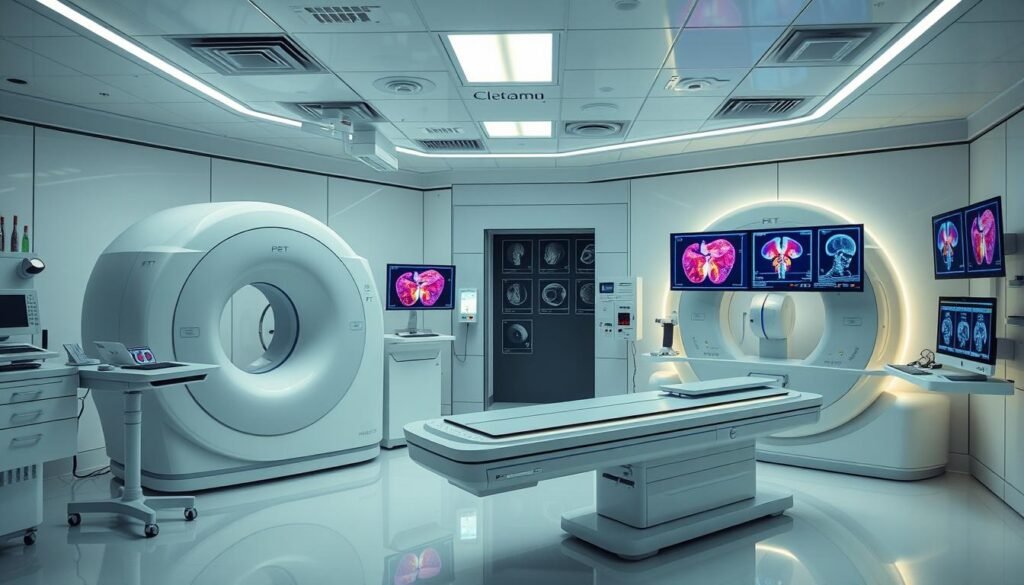
Advancements in Theranostics for Prostate Cancer
Recently, theranostics has changed prostate cancer treatment by combining diagnosis and therapy. It offers personalized care for patients. Biomarker assessment and tailored therapies help in creating more effective treatments. This is especially true for those with advanced prostate cancer.
Definition and significance of theranostics
Theranostics blends therapy and diagnostics for better treatment monitoring. It uses PSMA-targeted agents to find and treat cancer cells. These agents target prostate-specific membrane antigen, aiding in direct delivery of treatments and providing accurate diagnostic info. The ability to adjust treatments based on patient reactions enhances success rates.
Examples of PSMA-targeted theranostic agents
Several PSMA-targeted theranostic agents have advanced prostate cancer treatment:
- 177Lu-PSMA-617: Offers significant improvement in survival for patients with severe prostate cancer, becoming a key part of treatment plans.
- 68Ga-PSMA PET: Its high sensitivity and specificity are vital for making informed decisions about prostate cancer treatment.
- CD46-targeting agents: These target different cancer cell pathways, offering options for PSMA-negative patients and expanding treatment possibilities.
Research in PSMA-targeted theranostic agents is pushing towards dual therapy methods. These approaches not only improve treatment results but also aim to better the lives of those with prostate cancer.
Radionuclide Therapy: A Targeted Approach
Radionuclide therapy is a powerful tool against prostate cancer, especially the type that resists other treatments. It uses particles like Lutetium-177 to target cancer cells, but not hurt healthy ones. PSMA is an important target for this therapy as it’s found a lot in prostate cancer cells.
177Lu-PSMA-617 therapy has shown impressive results recently. More than 64% of patients saw a big drop in their PSA levels after treatment. Also, a meta-analysis showed that 51% of patients who had other treatments first saw over a 50% drop in PSA levels.
Radionuclide therapy causes fewer severe side effects than many traditional chemotherapies. For example, only 19% of patients on 177Lu-PSMA-617 saw their disease get worse over 12 months. This is much better than the 3% who did well on chemotherapy.
This therapy targets PSMA to treat cancer more accurately and allows for custom treatments. Advanced dosimetry means optimal doses for better outcomes and fewer risks.
Experts are looking into more PSMA targets and other particles for future therapies. This keeps hope alive for radionuclide therapy as a key prostate cancer treatment.
Personalized Medicine and Precision Oncology
Personalized medicine and precision oncology are changing the game for prostate cancer treatment. They move us past the old way where everyone got the same treatment. Now, treatment plans are made just for you, based on the special traits of your cancer. With the help of genetic and molecular tests, doctors can find specific markers. These markers help pick the best therapy, making treatments more effective.
Tailoring treatments to individual patient profiles
Customizing treatment is a big leap forward in fighting prostate cancer. Sadly, up to 40% of men see their cancer return after surgery or radiation. This shows how crucial it is to know a patient’s genetic details. About 23% of cases involve certain genes that help repair DNA. Knowing about these genes lets doctors use specific drugs, like Olaparib or Rucaparib. These drugs are showing good results in making patients live longer and shrink tumors.
Future directions in personalized therapy for prostate cancer
The future of prostate cancer care is looking bright with precision oncology. New methods, like PSMA PET scans, are getting better at spotting and tracking cancer. This means more accurate use of targeted therapies. The FDA just okayed a new treatment, 177Lu-PSMA-617, for a tough stage of prostate cancer. Scientists are busy studying more such treatments and immune therapies. These advances could make care much better for each person. For more on treatment choices, check out this detailed guide.
Clinical Applications of PSMA-Targeted Radiopharmaceuticals
PSMA-targeted radiopharmaceuticals are a big step forward in treating prostate cancer. Patients now see better results than with old treatments. These include 177Lu-PSMA-617 and 223Ra, which target cancer cells but spare healthy ones.
Current approved treatments and protocols
The world of PSMA therapies has changed quickly. Lutetium-177-PSMA-617 got the FDA’s okay for certain prostate cancer patients. These are ones who tried other treatments first. Clinical studies showed 70% had lower PSA levels, with half cutting their levels by more than 50% at eight weeks.
Radium-223 is also key for specific prostate cancer patients. It adds about 2.8 months to their lives, on average.
Potential for treatment in non-prostate malignancies
There’s also hope these treatments might work on other cancers, not just prostate. Research is looking into how they might attack other cancers where PSMA is found. This could change how we treat a variety of cancers, offering new hope.
| Treatment | Type | Indication | FDA Approval Year | Key Outcomes |
|---|---|---|---|---|
| Lutetium-177-PSMA-617 | Radiopharmaceutical | mCRPC with prior treatment | 2022 | 70% PSA decline, 50% experienced >50% drop |
| Radium-223 | Radiopharmaceutical | Symptomatic bone-predominant mCRPC | 2013 | Average survival extension of 2.8 months |
These PSMA-targeted treatments are changing how we fight cancer. They’re showing great results now and offer a bright future for cancer research.
Challenges and Limitations in Radiopharmaceutical Therapy
Radiopharmaceutical therapy has a lot of promise for treating prostate cancer. But it faces challenges, especially in clinical practice. These issues highlight the need for better treatment plans to improve patient care.
Common issues faced in clinical practice
Clinical practice faces several challenges when using radiopharmaceutical therapies. The availability of isotopes is a key factor. While some isotopes, like 18F and 99mTc, are easily available, others are not. This can make treatment inconsistent for patients.
Also, practitioners have to deal with different regulatory rules and safely handle radioactive materials. These challenges require careful navigation to ensure successful treatment.
Addressing patient variability and treatment responses
How patients react to radiopharmaceutical therapy can vary a lot. This is due to individual factors and tumor characteristics. Because of this, treatments need to be personalized to work best.
To improve responses, studies are looking at using radiopharmaceutical therapies earlier in cancer treatment. Combining treatments is another area being explored. Training healthcare providers better will also help address these challenges.
Tailoring therapy to each patient is crucial in overcoming these obstacles. For more information on personalized radionuclide therapy and its challenges, visit this source.
Future Perspectives on Radiopharmaceuticals Targeting PSMA
The treatment of prostate cancer is rapidly changing, thanks to new radiopharmaceuticals. These treatments target PSMA and are improving lives, especially for those with advanced cancer. The future looks promising as research continues to improve these therapies.
Scientists are making more compounds that can better target PSMA. Studies, like those on DOTA-PSMA-617, are showing good results. They’re finding ways to make these treatments work better and reach the right places in the body.
Treating advanced prostate cancer is hard. Doctors know they need to customize the treatment for each patient. The goal is to find the best drug for every patient’s unique cancer.
New ideas may change how we use PSMA-targeting treatments. Experts are looking into combining them with other therapies. This could help more people survive prostate cancer.
| Advancement Area | Description |
|---|---|
| Research and Development | Continued exploration of PSMA-targeted compounds to enhance efficacy. |
| Clinical Trials | Evaluation of therapies such as DOTA-PSMA-617 to establish optimal treatment protocols. |
| Personalized Medicine | Tailoring therapies based on individual genetic and tumor profiles. |
| Combination Therapies | Testing novel combinations with existing treatment modalities to improve outcomes. |
| Monitoring and Adaptation | Continual assessment of patient response to adjust therapies as needed. |
PSMA-targeted therapy is making big strides in treating prostate cancer. This progress shows great promise for the future. With ongoing research, we can hope for even better care for patients.
Conclusion
The findings show a big step forward in treating prostate cancer. Professionals in health care can now plan treatments with great precision. This is thanks to advancements in detection and therapies, especially PSMA PET/CT scans.
Metastatic castration-resistant prostate cancer still presents challenges. However, ongoing research and new treatments are promising. Therapies targeting PSMA are especially hopeful, offering more personalized care.
Every year, prostate cancer claims the lives of over 300,000 men worldwide. There’s a growing need for more effective treatments. By understanding the science behind prostate cancer and using better diagnostics, we can improve survival rates and patients’ lives. For more on the future of cancer care, see immunotherapy’s role in prostate cancer.