About 1 in 8 men will get prostate cancer in their life. This fact shows how crucial it is to know about locally advanced prostate cancer, especially stages T3 and T4. At these stages, the cancer has grown, making timely and proper care vital.
In this piece, we’ll cover the stages of prostate cancer, highlighting stages T3 and T4. We’ll explain the difference between localized, locally advanced, and metastatic cancer. This will help readers understand how each stage impacts treatment options.
We will also look at important tests and treatments for those with T3 and T4 prostate cancer. Learning about these aspects helps people know more about the disease. It also helps patients and their families prepare for what’s ahead. With better medicine and the importance of finding cancer early, knowing about this disease is essential.
Key Takeaways
- Locally advanced prostate cancer is classified as stages T3 or T4 within the AJCC TNM system.
- Stage T3 indicates that cancer has extended beyond the prostate gland, while T4 means it has invaded nearby organs.
- Assessment methods such as PSA testing and imaging are crucial for accurate staging.
- Staging influences treatment choices, significantly affecting patient outcomes.
- Understanding the differences between localized, locally advanced, and metastatic prostate cancer is essential for navigating the disease.
- Comprehensive treatment options are available and should be tailored to individual patient needs.
- Regular screenings and awareness of symptoms can lead to earlier diagnosis and better management.
Introduction to Locally Advanced Prostate Cancer
Locally advanced prostate cancer is mainly stages T3 and T4. At this stage, cancer has moved beyond the prostate. It may affect nearby structures like seminal vesicles, lymph nodes, and the bladder. Knowing about this type of cancer is key for choosing treatments and predicting outcomes.
This kind of cancer grows slowly but is close to important organs. This makes acting quickly very important. Regular check-ups, like PSA blood tests, are crucial for a good prognosis and creating a treatment plan. The state of health, tumor growth speed, and specific risks all play a part in how well treatments work.
To figure out how far the cancer has spread, doctors use scans and biopsies. There are many treatment paths for locally advanced prostate cancer. They could be surgery, radiation, or hormone therapy, depending on the situation of the patient.
It’s important for people with this illness to know about and use support services. Having information helps patients and their families deal with the cancer better. It leads to a deeper comprehension of the disease and what it means for their lives.
Understanding Locally Advanced Prostate Cancer
Locally advanced prostate cancer is a major health issue, covering stages T3 and T4 of the TNM system. This cancer type means the tumor has grown beyond its original location into nearby areas. It’s crucial to know the difference between locally advanced and metastatic cancer because the treatment differs greatly.
Definition and Overview of Locally Advanced Prostate Cancer
This cancer stage has moved outside the prostate to nearby tissues but hasn’t spread to distant organs. T3 shows the cancer has broken through the prostate capsule. T4 means it has reached neighboring organs or structures. With around 26,368 cases expected in 2024, it’s important to understand these terms for better management.
Differences Between Localized, Locally Advanced, and Metastatic Prostate Cancer
Knowing the differences between localized, locally advanced, and metastatic cancer is key for treatment plans. Localized tumors are still within the prostate. But locally advanced cancer affects surrounding areas. Metastatic cancer, however, has reached far-off sites in the body. With 90% of men initially diagnosed with local disease, early screening like PSA tests is vital.
To learn more about how to treat these stages, visit this page. It gives good details on the options for each cancer stage.
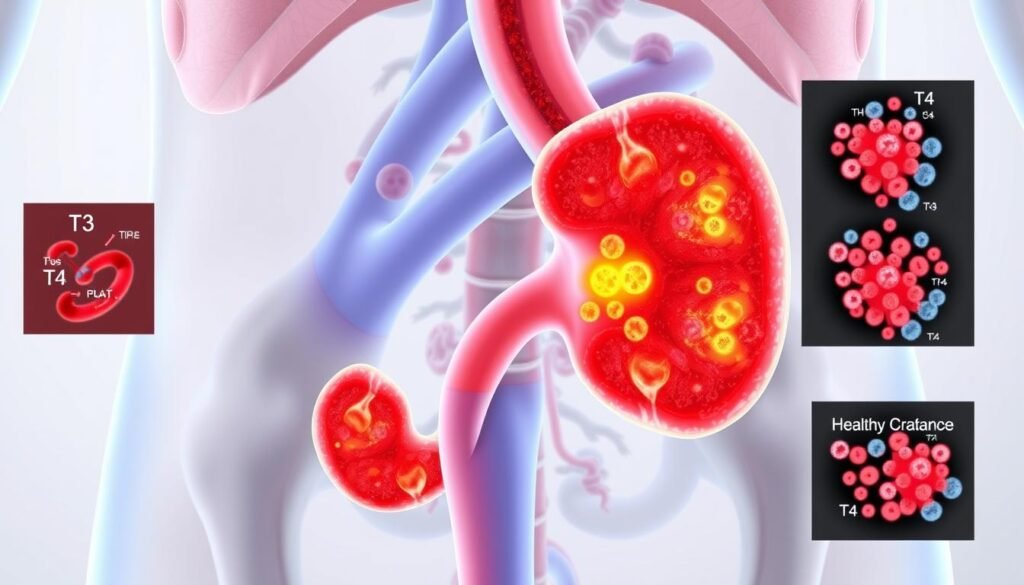
Prostate Cancer Staging Explained
Prostate cancer staging is key for picking the right treatment. Understanding the cancer’s stage at diagnosis helps doctors create a personal plan. It also hints at how well someone might do and their survival chances. The AJCC TNM system is mainly used to stage prostate cancer. It looks at three things: Tumor (T), Node (N), and Metastasis (M).
Importance of Staging in Treatment Decisions
Staging is vital for choosing the correct therapy. It ensures treatments match a patient’s health needs. Knowing the stage helps doctors understand:
- Local invasion of the tumor
- Spread to lymph nodes
- Presence of distant metastasis
This information helps pick the best treatment options and foresee outcomes. Someone with Stage T3 cancer might need a different strategy than someone with Stage T4.
Overview of the AJCC TNM Staging System
The AJCC TNM system puts prostate cancer into stages by specific criteria:
| Component | Definition |
|---|---|
| T (Tumor) | Shows the tumor’s size and extent. This can be T0 (no tumor) to T4 (tumor spread to nearby tissues). |
| N (Node) | Tells if cancer has reached nearby lymph nodes. N0 means no lymph nodes are involved, N1 means there are. |
| M (Metastasis) | Indicates if cancer has spread far from the original site. M0 means it hasn’t, M1 means it has. |
Prostate cancer stages also consider PSA levels and the Gleason score. These show how aggressive the cancer is and the chance it will come back. The risk groups—very low, low, intermediate, high, very high—help doctors understand treatment needs and what patients can expect.
T3 Stage of Prostate Cancer
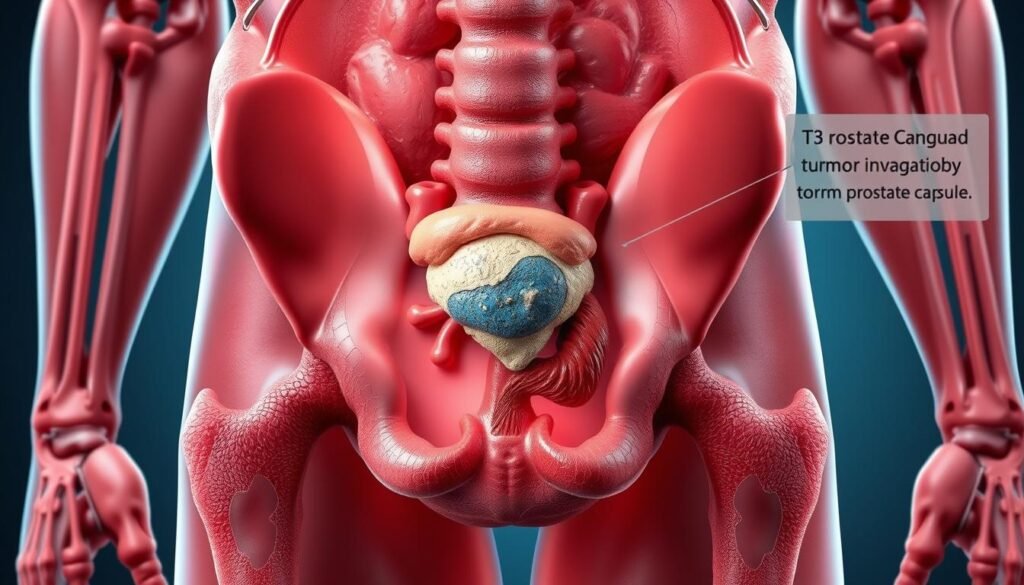
The T3 stage of prostate cancer means the tumor has grown outside the prostate. It’s not in nearby lymph nodes or distant organs yet. Knowing this stage helps doctors figure out the outlook for patients. The T3 stage is split into T3a and T3b. T3a is when the tumor has broken through the prostate capsule. T3b means the cancer has spread to the seminal vesicles.
Characteristics of T3 Stage
This stage is defined by the TNM staging system. This system shows how far prostate cancer has spread. At the T3 stage, the cancer has grown beyond the prostate itself. Doctors use tools like the Partin Nomogram to understand the disease’s spread. This helps pick the best treatment methods.
- T3a: Tumor invades the prostate capsule
- T3b: Tumor has spread to the seminal vesicles
Knowing the details of this stage is key to choosing the right treatment. It helps in getting better results for patients.
Prognostic Implications of T3 Stage in Prostate Cancer
The outlook for T3 stage prostate cancer depends on many things. These include the tumor’s grade, PSA levels, and the patient’s own health. Doctors look at various risk factors to guess survival rates. The Cambridge Prognostic Group classifies prostate cancer into risk groups using T staging, Gleason scores, and PSA levels.
Finding the cancer early and starting treatment quickly can lead to better survival rates. Guides like the AJCC Cancer Staging Manual and ESMO guidelines offer important information. Doctors use tools like Predict Prostate to choose the best treatment for T3 stage prostate cancer.
More about prostate cancer staging can be found here
| Stage | Description | Characteristics |
|---|---|---|
| T3a | Tumor invades the prostate capsule | Beyond the prostate but not to seminal vesicles |
| T3b | Tumor has spread to seminal vesicles | Extension marks a more advanced stage of cancer |
T4 Stage of Prostate Cancer
The T4 stage of prostate cancer is quite serious. It means the cancer has spread beyond the prostate to nearby organs. This includes the bladder or rectum. This stage shows the cancer is more aggressive.
Characteristics of T4 Stage
T4 stage prostate cancer has several key features:
- Spread to Nearby Organs: It may spread to the bladder, rectum, or pelvic wall.
- Symptoms: Symptoms can include trouble urinating, blood in urine or semen, and pain in the back, hips, or pelvis.
- Treatment Limitations: There are treatments to manage symptoms and slow the cancer. However, curing it is rare.
- Risk Factors: Risk factors include age, family history, and being Black.
Differences Between T3 and T4 Stages
Knowing the differences between T3 and T4 stages helps in planning treatment. Here’s a brief comparison:
| Characteristic | T3 Stage | T4 Stage |
|---|---|---|
| Cancer Spread | Extends outside the prostate but not to adjacent organs | Invades adjacent organs (bladder, rectum, pelvic wall) |
| Common Symptoms | Possible urinary difficulties, but less severe | Significant urinary obstruction, pelvic pain, presence of blood |
| Treatment Options | Surgery, radiation, hormone therapy may be more effective | Focus on symptom management; treatments can slow progression |
| Prognosis | Generally better outcomes if localized | Less favorable outcomes, often more aggressive behavior |
Understanding T3 and T4 stages helps customize treatment plans. Managing T4 prostate cancer well requires focusing on the disease and improving patients’ life quality.

Diagnostic Procedures for Staging
To correctly diagnose and stage prostate cancer, doctors use several diagnostic procedures. These include PSA tests, imaging tests, and biopsies. Each of these tests provides crucial details for planning the right treatment.
PSA Tests in Prostate Cancer Diagnosis
The PSA test is a key screening tool for prostate cancer. It looks at levels of prostate-specific antigen in the blood. Here’s what the levels mean:
- PSA levels under 4 ng/mL usually mean no prostate cancer.
- Levels between 4 and 10 ng/mL show about a 25% chance of having prostate cancer.
- PSA levels over 10 ng/mL suggest a more than 50% risk of the disease.
These readings help find men who are at risk, mainly those over 60. Other risk factors include family history and a diet high in processed meats. The Gleason scoring system then assesses how aggressive the cancer may be. Scores of 3 or higher are common among cancers found.
Role of Imaging Tests and Biopsies
Imaging tests like CT scans and MRIs are crucial for spotting how far the cancer has spread. They can see if cancer has reached nearby lymph nodes or organs. If imaging spots anything odd, biopsies are needed to confirm cancer.
Biopsies do more than confirm cancer. They also tell us how aggressive the cancer is through Gleason scores. These scores go from 2 to 10. Lower scores mean the cancer is well-differentiated, while higher scores signal more aggressive diseases.
| PSA Level | Risk of Prostate Cancer |
|---|---|
| Under 4 ng/mL | Low risk |
| 4 – 10 ng/mL | Approximately 25% chance |
| Above 10 ng/mL | Over 50% chance |
Doctors combine findings from PSA tests, imaging, and biopsies to craft the best treatment plan. It’s tailored to the specific stage of the patient’s prostate cancer.
Prognostic Groups and Risk Stratification
It’s really important for people with locally advanced prostate cancer to understand the Cambridge Prognostic Group. This system breaks down prostate cancer into different groups. These groups are based on things like Grade Groups, T stage, and PSA levels. Knowing the risk well helps doctors give the right advice on treatment and what to expect.
Understanding the Cambridge Prognostic Group (CPG)
The Cambridge Prognostic Group sorts prostate cancer into five risk groups, from CPG1 to CPG5. Each level shows a different risk of the cancer getting worse. For example, CPG1 means a better outlook with a Gleason score of 6. On the other hand, CPG4 is more serious with a Gleason score of 8 and PSA over 20 ng/ml. This system helps doctors create treatment plans that fit each patient’s specific needs.
Factors Influencing Prognosis
Several key factors help decide how a patient might do with their cancer. Important things include:
- Clinical T stage: This is about how much the cancer has spread. T3 or T4 means it’s more advanced.
- Serum PSA levels: High PSA levels can mean the cancer is more aggressive.
- Grade Group: The Gleason score shows how much cancer cells look like normal cells. This helps decide on treatment.
- Patient’s age and overall health: These greatly impact what treatments are chosen and the results they can expect.
Risk stratification helps doctors give care that’s right for each patient, based on their unique cancer. This custom care boosts chances of living longer and better lives.
| Cambridge Prognostic Group | Gleason Score | PSA Level (ng/ml) | T Stage |
|---|---|---|---|
| CPG1 | 6 | Less than 10 | T1 or T2 |
| CPG4 | 8 | Higher than 20 | T3 |
Good risk stratification and understanding prognosis factors help guide to the best treatment. This makes sure patients get the care they truly need.
Treatment Options for Stages T3 and T4
When dealing with stages T3 and T4 prostate cancer, knowing the treatment options is key. These treatments can help improve a patient’s outcome. Patients must understand the different treatments available, as choices depend on personal circumstances and health.
Treatments range from surgery to radiation and hormone-based therapies. This variety ensures patients get care tailored to their needs.
Surgical Options for Locally Advanced Prostate Cancer
For locally advanced prostate cancer, surgery is a critical option. A prostatectomy, which removes the prostate gland, is a common choice. It’s mainly for cases where cancer hasn’t spread far.
Deciding on surgery involves looking at the patient’s age, health, and cancer’s traits. The Gleason score, indicating cancer’s aggressiveness, helps guide this choice.
Radiation Therapy for Staging T3 and T4
Radiation therapy is another core treatment for T3 and T4 stages. It includes external beam radiation or brachytherapy. These treatments aim to kill cancer cells and slow progression.
For some, radiation pairs with other therapies for better results. Studies show combining it with hormone therapy improves outcomes for high-risk patients.
Role of Hormone Therapy in Treatment
Hormone therapy plays a key role in treating locally advanced prostate cancer. It’s especially useful when surgery isn’t an option. By lowering androgen levels, it cuts testosterone’s support for cancer cells.
Studies praise immediate androgen deprivation therapy for enhancing survival. Often, hormone therapy is part of a broader treatment plan to ensure both effectiveness and quality of life.
For a detailed look at treatment options, visit treatment options for prostate cancer. Patients and doctors should work together to choose the best treatment for the patient’s unique health situation.